From a Blocked Lovable Store to a Shopify-Powered E-Commerce Platform
A client spent hours adding products manually through Lovable before the project became blocked. See how Entro Solutions connected the storefront to Shopify and turned it into a manageable e-commerce system.
AI development tools have made it possible to turn an idea into a working interface faster than ever. A business owner can describe a page, request a new feature, and see the result appear without following a traditional development process.
That speed is valuable, but a good-looking storefront is only one part of an e-commerce platform.
One of our clients discovered this after building an online store with Lovable. The project initially moved quickly. The storefront was taking shape, the design looked promising, and the client could make changes through chat instead of managing a conventional codebase.
Then it was time to add the products.
The hidden cost of adding products through chat
The client already had a product catalog, but the Lovable project was not connected to the system where that catalog belonged. Instead, each product had to be described and uploaded manually through the chat.
Product by product, the client entered titles, descriptions, prices, images, and other details. Every new item consumed more time. Corrections required more prompts. Updating the catalog meant returning to the same manual process.
After spending hours adding products one by one, the client became blocked. The problem was no longer the storefront design. It was the lack of a proper commerce backend.
The store needed more than pages containing product information. It needed a dependable system for managing:
Products and variants
Prices and inventory
Product images and descriptions
Customer information
Checkout and payments
Orders and fulfillment
Future catalog updates
Trying to recreate all of this inside an AI-generated application would have added unnecessary development time and risk. More importantly, the client already had access to a platform designed to handle these responsibilities: Shopify.
The client hired Entro Solutions to finish the project
When the client contacted Entro Solutions, our first task was not to rebuild everything.
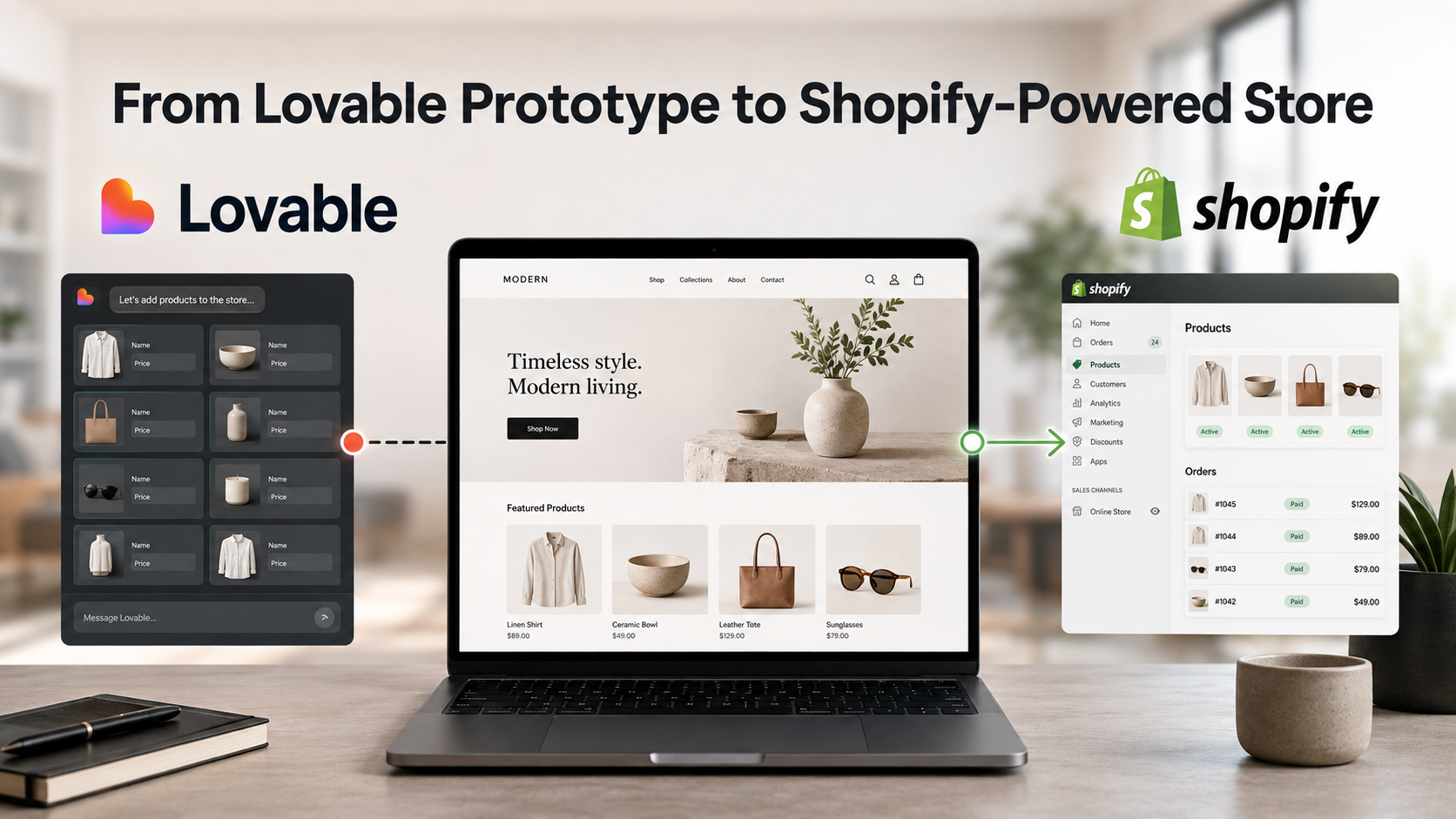
The Lovable storefront already represented useful work. The sensible approach was to preserve its customer-facing experience while replacing the fragile product workflow behind it.
We reviewed the project and separated it into two clear responsibilities:
Lovable would remain responsible for the storefront experience.
Shopify would become the commerce engine and source of truth.
This architecture gave the client the benefit of the interface they had already created while removing the need to manage commercial data through prompts.
Removing the manually uploaded products
The products entered manually into the Lovable project had become duplicate data. Keeping them would create two separate catalogs, each capable of becoming outdated.
For example, a price could be changed in Shopify but remain unchanged on the storefront. An unavailable product could still appear for sale. New images or descriptions would have to be updated in two places. Over time, these small differences would create customer confusion and order problems.
We removed the manually maintained product data and made Shopify the single source of truth.
The client could now manage the catalog from Shopify’s established administration interface instead of asking an AI chat to create or edit products individually.
Connecting the Lovable storefront to Shopify
We integrated the storefront with Shopify so that its product data could be loaded directly from the Shopify catalog.
The integration allowed the application to retrieve the information required by the customer-facing pages, including product names, descriptions, images, prices, variants, and availability.
When information changes in Shopify, the storefront can use the current data instead of relying on a manually copied version.
This changed the client’s workflow completely.
Instead of uploading a product through chat and hoping every field was represented correctly, the client could create or update it once in Shopify. The connected storefront then displayed the catalog from the system designed to manage it.
Handling orders through the Shopify API
Products were only half of the problem. A real e-commerce application also needs a dependable order lifecycle.
We connected the order flow through the Shopify API so Shopify could continue to handle the operational side of commerce. This included keeping orders in a familiar backend where the client could manage customer details, payment status, fulfillment, and ongoing processing.
The customer still interacts with the custom storefront, but the business does not need to invent a second order-management system behind it.
That distinction matters.
Building a custom interface can create a unique shopping experience. Rebuilding catalog management, checkout logic, order processing, and commerce administration from zero is a much larger commitment.
Lovable was not the problem
It would be easy to conclude that the client chose the wrong tool. That is not the lesson from this project.
Lovable helped the client move from an idea to a visible storefront quickly. The problem appeared when a rapid prototyping workflow was also expected to replace a complete commerce platform.
AI builders are powerful when used for the right layer of a product. They can accelerate interface creation, validate ideas, and help businesses reach a working prototype sooner.
However, they do not remove the need for architecture, integrations, data ownership, security, and reliable business operations.
In this case, Lovable and Shopify were more useful together:
Lovable provided the flexible customer-facing experience.
Shopify provided structured product management and commerce operations.
The API integration kept both sides connected.
The result was not a choice between an AI-built application and Shopify. It was a system that used each technology for what it does best.
When an AI-built project needs professional development
Many AI-built projects reach the same turning point. The first version appears quickly, but progress slows when the application needs to connect to real business systems.
Typical warning signs include:
Business data is being copied manually into the application.
Products, customers, or orders exist in more than one place.
Every content update requires another chat prompt.
The project lacks a clear source of truth.
Checkout, payment, or order workflows are incomplete.
A new integration causes existing functionality to break.
The owner is spending more time correcting the tool than running the business.
At this stage, the work already completed does not necessarily need to be discarded.
An experienced development team can inspect the current application, preserve the valuable parts, and connect it to production-ready services.
Build quickly, but choose the architecture early
The biggest mistake in this project was not using Lovable. It was beginning manual product entry before deciding where products and orders should live.
For any e-commerce project, that decision should be made early:
Which system owns the product catalog?
Where are prices and inventory updated?
Which platform processes checkout and payments?
Where does the team manage orders?
How does the storefront receive current data?
Once those responsibilities are clear, AI development tools can accelerate the work without creating an operational bottleneck.
Need help finishing an AI-built application?
If you have started a project in Lovable or another AI development platform and are now blocked by APIs, payments, databases, authentication, or third-party integrations, you may not need to start again.
Entro Solutions helps businesses turn promising AI-built prototypes into dependable applications.
We can review your current project, identify what should be preserved, and build the technical connections required for real-world operation.
Contact Entro Solutions to discuss your project.