Automating Hair Counting with YOLOv5 and Custom Models: An Entro Solutions Innovation
Automating Hair Counting with YOLOv5 and Custom Models: An Entro Solutions Innovation
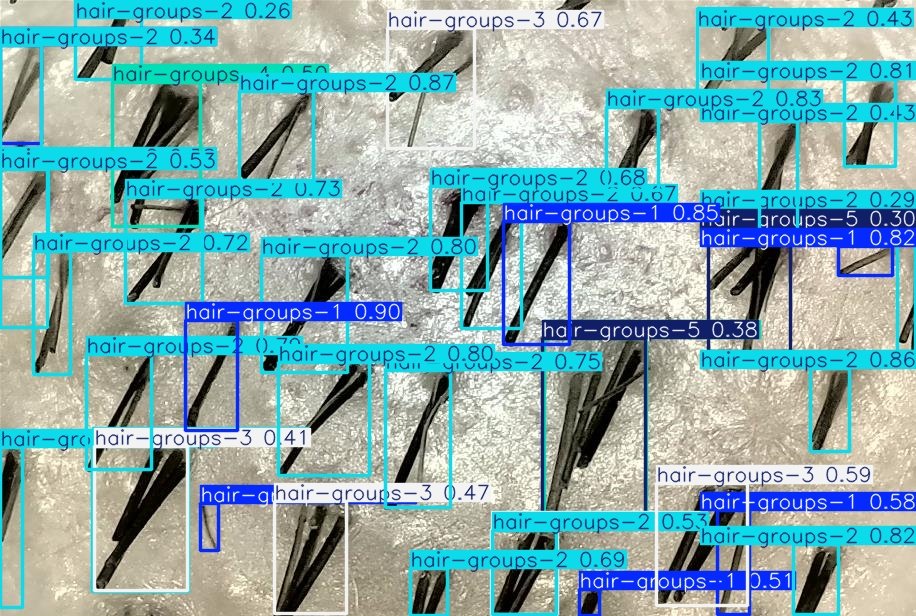
At Entro Solutions, we are passionate about driving innovation through technology. One of our recent breakthroughs is a revolutionary hair-counting system that uses artificial intelligence to automate the tedious process of hair and follicle detection. Our system, built using the cutting-edge YOLOv5 architecture, offers unprecedented accuracy and efficiency, significantly reducing the time and effort required for manual hair counting.

In this article, we’ll take you behind the scenes to explore how our team developed this powerful tool, and how it can be customized for a wide variety of applications.
The Need for Automated Hair Counting
In industries such as cosmetics, dermatology, and medical research, hair counting is a vital task. It is used to measure hair density, track hair growth, or analyze hair loss patterns. Traditionally, this process has been done manually—a time-consuming and error-prone method. Manual counting is also limited in scale, as analyzing a large number of images or individuals is both labor-intensive and costly.
Recognizing this challenge, Entro Solutions embarked on a mission to automate the process using artificial intelligence. Our goal was to create a system that not only detects and counts hairs but can also be extended to detect hair follicles and other related features, providing more comprehensive data for hair care professionals and researchers.
The Journey from Concept to Deployment
The idea for the hair counting system was born out of a need to provide accurate, fast, and scalable results. Entro Solutions has always been at the forefront of custom AI solutions, so when approached with this challenge, we knew that using an object detection model like YOLOv5 would be ideal. However, while YOLOv5 was known for its speed and accuracy, it had never been specifically used for something as granular as hair detection, where the objects of interest can be small, fine, and densely packed.
We knew we had to customize and fine-tune the model to handle the nuances of this problem. Here's how we did it.
Phase 1: Understanding the Challenges of Hair Detection
When we first embarked on this project, we identified several key challenges:
- Size and Density: Individual hairs are small and often overlap, making it difficult for a standard object detection model to differentiate between them.
- Variations in Hair Types: Hair comes in many types—straight, curly, thick, thin—and detecting each requires the model to generalize well across these variations.
- Environmental Factors: Lighting, scalp texture, and image quality can all affect how well hairs and follicles are detected.
Our team of data scientists and AI engineers spent a considerable amount of time understanding these factors and selecting the right dataset to ensure that the model would be robust and capable of performing across various scenarios.
Phase 2: Preparing a Comprehensive Dataset
The foundation of any AI system is the data it’s trained on. At Entro Solutions, we put together a vast and diverse dataset that would provide the model with the variety it needed to generalize well. This included:
- High-resolution images: Capturing different hair types (curly, straight, wavy) and hair densities.
- Diverse lighting conditions: Ensuring the model performs well under different environmental lighting scenarios.
- Annotations for both hairs and follicles: This allowed the model to learn to detect hairs while also being able to identify the follicles from which they grow.
Our data was carefully annotated by trained professionals to ensure that each hair and follicle was accurately labeled. We then split the dataset into training, validation, and testing sets to ensure the model could learn effectively and be evaluated rigorously.
Phase 3: Training the YOLOv5 Models
With our dataset prepared, the next step was training the model. We chose YOLOv5 due to its ability to perform real-time object detection, making it ideal for scenarios where speed and accuracy are paramount. However, we knew that training a general-purpose model like YOLOv5 to detect something as specific as hairs would require fine-tuning and customization.
At Entro Solutions, we trained three separate models:
- The Hair Model: This model was dedicated solely to detecting individual hair strands. Given the small size of the target objects (hairs), the model was trained with high-resolution images and optimized to detect even the finest details.
- The Follicle Model: Understanding that detecting follicles is crucial for certain applications, we trained a second model to focus exclusively on follicle detection. This model uses the same principles as the hair detection model but was optimized to detect larger, more defined features.
- The Multi-Class Model: For more advanced users, we developed a multi-class model that could detect both hairs and follicles, as well as any additional custom objects that might be relevant in future applications (e.g., scalp conditions or hair products).
We utilized transfer learning to accelerate the training process, leveraging pre-trained YOLOv5 models and fine-tuning them on our custom dataset. This approach allowed us to reduce the training time while ensuring the model was highly accurate and effective for our specific use case.
Phase 4: Fine-Tuning for Optimal Performance
Training an AI model is an iterative process. We spent a significant amount of time fine-tuning our models to ensure they delivered optimal performance. This involved:
- Adjusting learning rates: Ensuring that the model learned at the right pace and didn’t overfit to the training data.
- Balancing accuracy and speed: Since real-time performance was critical for our clients, we optimized the models to deliver fast, accurate results without compromising on quality.
- Model validation: After each round of training, we rigorously tested the model on our validation set to ensure it performed well across different hair types and conditions.
Phase 5: Real-World Testing and Deployment
Once the models were fully trained and fine-tuned, we began testing the system in real-world scenarios. Entro Solutions worked closely with industry professionals to validate the model’s performance in various practical applications, including:
- Hair density analysis for cosmetic companies looking to measure the effectiveness of hair growth treatments.
- Dermatological research for analyzing hair loss patterns and scalp conditions.
- Automated reporting to generate detailed analyses based on the detected hairs and follicles.
Our clients were impressed by the system’s accuracy, especially in challenging conditions where traditional manual methods would have been prone to error.
The Results: Accurate, Scalable Hair Counting
The hair counting system developed by Entro Solutions represents a significant leap forward in automation and accuracy. By harnessing the power of AI, our system can:
- Count individual hairs with remarkable accuracy.
- Detect hair follicles and other relevant features.
- Scale effortlessly to handle large datasets, making it suitable for both small and large-scale analyses.
Moreover, our multi-class model can be customized to detect additional objects or features, making it a versatile tool for various industries. Whether you’re a cosmetic company measuring the success of a product or a researcher studying hair loss, this system is designed to meet your needs.
The Future of Hair Counting with AI
At Entro Solutions, we are constantly looking for ways to improve our technology. Our hair counting system is just the beginning. In the future, we plan to expand the system’s capabilities to include more advanced features, such as:
- Hair growth tracking over time: Using AI to track changes in hair density and growth patterns over multiple sessions.
- Scalp condition analysis: Detecting and classifying scalp conditions alongside hair detection.
- Personalized recommendations: Integrating the system with other technologies to provide personalized hair care recommendations based on the data collected.
We are proud of the work we’ve done and excited about the future possibilities.
Why Choose Entro Solutions?
At Entro Solutions, we combine cutting-edge AI technology with a deep understanding of our clients’ needs. Our team of experts is dedicated to creating innovative solutions that drive efficiency, accuracy, and success. Whether it’s hair counting, object detection, or any other AI application, Entro Solutions is here to help.
If you’re looking for a custom solution or want to learn more about how our hair-counting system can benefit your business, don’t hesitate to contact us.